Be yourself; Everyone else is already taken.
— Oscar Wilde.
This is the first post on my new blog. I’m just getting this new blog going, so stay tuned for more. Subscribe below to get notified when I post new updates.
Be yourself; Everyone else is already taken.
— Oscar Wilde.
This is the first post on my new blog. I’m just getting this new blog going, so stay tuned for more. Subscribe below to get notified when I post new updates.
A Walk to Remember
By: Jessica Sanchez
The photo pictures Jamie Sullivan (Played by Mandy Moore) and Landon Cater (played by Shane West) preforming in the school play in which Landon is forced to participate in as punishment.
Those who know me know how I feel about romance movies but there is something about this movie that just speaks to me. “A Walk to Remember” is a love story so sweet, sincere and positive that it sneaks past the defenses built up in this age of irony. It tells the story of a romance between two 18-year-old that is summarized when the boy tells the girl’s doubtful father: “Jamie has faith in me. She makes me want to be different. Better.” After all the vulgar crudities of the typical modern teenage movie, here is one that looks closely, pays attention, sees that not all teenagers are as cretinous as Hollywood portrays them.
The singer Mandy Moore, a natural beauty in both face and manner, stars as Jamie Sullivan, an outsider at school who is laughed at because she stands apart, has values, and always wears the same ratty blue sweater. Her father (Peter Coyote) is a local minister. Shane West plays Landon Carter, a senior boy who hangs with the popular crowd but is shaken when a stupid dare goes wrong and one of his friends is paralyzed in a diving accident. He dates a popular girl and joins in the laughter against Jamie. Then, as punishment for the prank, he is ordered by the principal to join the drama club: “You need to meet some new people.” Jamie’s in the club. He notices her in a new way. He asks her to help him rehearse for a role in a play. She treats him with level honesty. She isn’t one of those losers who skulks around feeling put upon; her self-esteem stands apart from the opinion of her peers. She’s a smart, nice girl, a reminder that one of the pleasures of the movies is to meet good people.
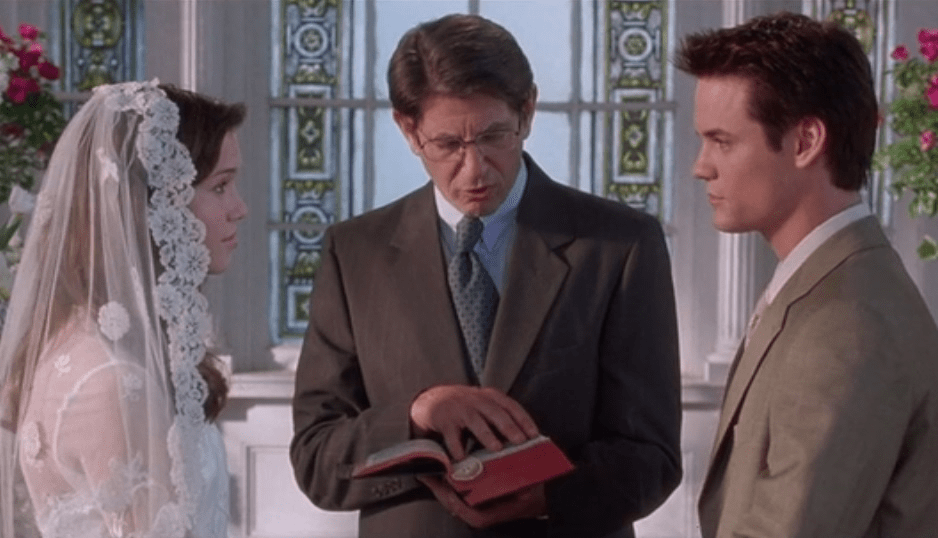
The photo pictures Jamie Sullivan, Reverend Sullivan (played by Peter Coyote), and Landon Cater being married in the church in which her parents were married get her father to perform the wedding ceremony.
While Jamie is the butt of jokes and the object of ridicule among her classmates, she not only wins in the end, but it is she who holds moviegoers’ empathy throughout. This is no cardboard caricature. Moore has turned Jamie into a living, breathing Christian that you can cheer for and cry for. When a rudely doctored photo of her wearing nothing but sexy underwear circulates at school, it’s only funny to those who perpetrated the prank. Theater audiences care only for how this cruelty makes Jamie feel. Even in the wake of such treatment, Jamie is never ashamed of her faith. Neither is she snobbish or self-righteous. Snappy comebacks reveal a cultural awareness and sly wit not often present in Christian characters.
Landon never accepts Christ as his personal Savior onscreen. But the tangible fruits of his transformation are of spiritual proportions. Christ is the only one capable of effecting permanent change in a man’s life. Landon evidences just that sort of conversion. Human love for another person only lasts so long. Christ’s love and reconstructive work lasts forever. It will be impossible for Christian viewers to conclude that Landon is merely responding to a pheromone attraction to Jamie. As stated, Landon’s friends make fun of Jamie at almost every opportunity.
And they direct their derision at Landon when he sides with her. Then the tide turns. One by one, as the film winds down, they each seek out Landon and express sorrow for their hurtful actions and harsh words. They aren’t changed forever as Landon is, but even removed as they are from the central story line, they realize what’s right and that they haven’t done it.
The movie walks a fine line with the Peter Coyote character, whose church Landon attends. Movies have a way of stereotyping reactionary Bible-thumpers who are hostile to teen romance. There is a little of that here; Jamie is forbidden to date, for example, although there’s more behind his decision than knee-jerk strictness. But when Landon goes to the Rev. Sullivan and asks him to have faith in him, the minister listens with an open mind.

This photo is a scene from the movie where Jamie tells Landon has leukemia and she just wants to be happy within her last couple of months.
Yes, the movie is corny at times. But corniness is all right at times. I forgave the movie its broad emotion because it earned it. It lays things on a little thick at the end, but by then it had paid its way. Director Adam Shankman and his writer, Karen Janszen, working from the novel by Nicholas Sparks, have an unforced trust in the material that redeems, even justifies the broad strokes. They go wrong only three times: (1) The subplot involving the paralyzed boy should have either been dealt with, or dropped; (2) It’s tiresome to make the black teenager use “brother” in every sentence, as if he is not their peer but was ported in from another world; (3) As Kuleshov proved more than 80 years ago in a famous experiment, when an audience sees an impassive closeup, it supplies the necessary emotion from the context. It can be fatal for an actor to try to “act” in a closeup, and Landon’s little smile at the end is a distraction at a crucial moment.
Those are small flaws in a touching movie. The performances by Moore and West are so quietly convincing we’re reminded that many teenagers in movies seem to think like 30-year-old stand up comics. That Jamie and Landon base their romance on values and respect will blindside some viewers of the film, especially since the first five or 10 minutes seem to be headed down a familiar teenage movie trail. “A Walk to Remember” is a small treasure.
This is an example post, originally published as part of Blogging University. Enroll in one of our ten programs, and start your blog right.
You’re going to publish a post today. Don’t worry about how your blog looks. Don’t worry if you haven’t given it a name yet, or you’re feeling overwhelmed. Just click the “New Post” button, and tell us why you’re here.
Why do this?
The post can be short or long, a personal intro to your life or a bloggy mission statement, a manifesto for the future or a simple outline of your the types of things you hope to publish.
To help you get started, here are a few questions:
You’re not locked into any of this; one of the wonderful things about blogs is how they constantly evolve as we learn, grow, and interact with one another — but it’s good to know where and why you started, and articulating your goals may just give you a few other post ideas.
Can’t think how to get started? Just write the first thing that pops into your head. Anne Lamott, author of a book on writing we love, says that you need to give yourself permission to write a “crappy first draft”. Anne makes a great point — just start writing, and worry about editing it later.
When you’re ready to publish, give your post three to five tags that describe your blog’s focus — writing, photography, fiction, parenting, food, cars, movies, sports, whatever. These tags will help others who care about your topics find you in the Reader. Make sure one of the tags is “zerotohero,” so other new bloggers can find you, too.

 Jessica's Film Review Blog